
Mecklenburg Court Records After Arrest
After a Mecklenburg County jail arrest, the first public record usually comes from the Mecklenburg County Sheriff's Office. The Arrest Processing Center creates the booking entry, takes fingerprints, records the mugshot, and sends charge and bond data into the jail Offender Management System. That record is useful, but it is not the court case. MCSO says charges are not convictions and directs people who need case detail to the Clerk of Superior Court.
The court side is handled by the North Carolina Judicial Branch, the Mecklenburg County Clerk of Superior Court, and the Mecklenburg County District Attorney's Office for Prosecutorial District 26. The prosecutor reviews the arrest, supporting papers, and legal basis for charges. Filed charges can match the booking charge, but they can also be amended, reduced, dismissed, or replaced by an indictment. Custody and booking details belong on the Mecklenburg County jail inmate records page, while booking photos and mugshot limits belong with Mecklenburg County jail mugshots. Court records after a jail arrest focus on case numbers, court dates, filed documents, charge status, bond orders, warrants that have been served, and final dispositions.
Find Court Records After Arrest
For Mecklenburg County criminal cases, start with the North Carolina eCourts Portal. The Mecklenburg County court page says eCourts is the electronic access route for public case information, court dates, documents, and payments in Mecklenburg. The same county court page says public records are available onsite at the courthouse during operating hours. If the jail roster shows a CASE number, use it as the strongest bridge between the jail record and the court case.
The Mecklenburg County Judicial Branch page is the local court access hub. It gives the eCourts notice, public record access hours, court calendars, and the older-document request process. The Judicial Branch court records help topic also explains public terminals, paper files, online Portal searches, and copy access.
| Search field | Type | Required | Use in Mecklenburg cases |
|---|---|---|---|
| Name | Smart search or text | Optional if case number is known | Useful for defendant lookup when the jail record has no case number. |
| Case Number | Text | Optional | Best match when MCSO charge detail shows CASE or a court docket number. |
| Citation Number | Text | Optional | Useful for traffic or citation-based criminal matters. |
| Attorney | Text | Optional | Can help locate calendars or cases tied to counsel. |
| County | Dropdown or filter | Optional | Use Mecklenburg County to narrow statewide Portal results. |
| Hearing date | Search mode | Optional | Helps confirm upcoming court dates after booking. |
- Start with MCSO Arrest Inquiry or Inmate Inquiry and record the name spelling, DOB, PID, JID, arrest number, arrest date, and any CASE number shown in charge detail.
- Read the MCSO charge list as booking data. The FAQ says charge fields include CASE, description, process type, charge type, bond, and bond type.
- Open eCourts Portal and search by defendant name with Mecklenburg County selected. Use the case number if the jail record gives one.
- Compare the court charge description, court date, case status, and disposition against the jail charge. The court case controls the outcome.
- For documents filed before October 9, 2023 that are not in Portal, use the Mecklenburg court page's clerk email process for the proper division.
Pre-October 9, 2023 files need special care. The Mecklenburg court page says electronic copies of criminal, civil, or estate and special proceedings documents filed before that date may be requested by email from the relevant Clerk division when they cannot be found in Portal. A criminal file request should include the type of record requested, party names, and the file number if known. Paper files, certified copies, and older records may still require the Clerk of Superior Court at the Mecklenburg County Courthouse, 832 East Fourth Street, Charlotte, NC 28202, during public hours.
Mecklenburg Charging Documents
Charging papers explain why a jail arrest became a court case. Mecklenburg County records use several local cues. MCSO's FAQ includes process types such as REL for a magistrate's order, ARREST for an arrest warrant, FTA for failure to appear, PV for probation violation, and GJI when the Grand Jury returned an indictment. Those codes describe the jail or process basis for custody. The formal court file should be checked for the current charge and the next hearing.
| Document or process | Who creates it | Where it matters | What to verify |
|---|---|---|---|
| Magistrate's order or release order | Magistrate after arrest processing | Early custody, charge, and release conditions | Bond type, first appearance, and whether conditions changed in court. |
| Warrant or order for arrest | Court or judicial officer | Served process that leads to booking | Whether it is served, active in the case, or tied to failure to appear. |
| Prosecutor-filed charge | Mecklenburg County District Attorney's Office | Criminal court case | Whether the DA kept, reduced, amended, or dismissed the arrest charge. |
| Grand jury indictment | Grand jury | Felony prosecution in Superior Court | Whether a GJI or indictment supersedes the booking charge. |
The District Attorney's Office serves every Mecklenburg municipality, including Charlotte, Cornelius, Davidson, Huntersville, Matthews, Mint Hill, and Pineville. District Attorney Spencer B. Merriweather III has served since 2017, according to the office's public biography. The DA does not run the jail roster. The DA prosecutes the criminal case after arrest, and that is why the court record may change even when the original MCSO booking record remains visible in the three-year public jail data window.
Mecklenburg Charge Status Table
Charge status terms can mean different things in the jail system and the court system. MCSO disposition codes are roster codes for the jail record. Court disposition terms are the authoritative case outcome. A Mecklenburg County court records after arrest review should never treat a jail code as the final criminal history result.
| Status | Where it appears | Plain meaning |
|---|---|---|
| Pending | Court case | The case or charge is still open and no final disposition has been entered. |
| Active | MCSO disposition code A | The charge or process remains active in the jail context. |
| Bonded | MCSO disposition code B | The jail record shows a bonded status, but court dates may remain active. |
| Expired | MCSO disposition code E | The jail process has expired in MCSO records. |
| Inactive | MCSO disposition code I | The jail record is no longer active for that process. |
| Dismissed or voluntary dismissal | Court case | The prosecutor or court ended the charge. Do not equate every dismissal with MCSO code VDGJ. |
| Amended or reduced | Court case | The prosecutor or court changed the offense from the original arrest charge. |
| Convicted or not guilty | Court case | The charge reached a judgment, plea, trial verdict, or acquittal. |
Bond After Mecklenburg Arrest
Bond is the release condition tied to the arrest and court process. MCSO charge records list BOND and BOND TYPE. Common local codes include SEC for secured bond, UNS for unsecured bond, CASH for cash only, CUST for release to custody of another person, NONE for no bond, and VDGJ as a roster code that should not be read as ordinary payment advice. Records and Release updates charge and bond data after court appearances and verifies release eligibility before a person leaves custody.
| Bond type or code | How it works in Mecklenburg records |
|---|---|
| SEC | Secured bond. Release requires money, security, or a bonding arrangement. |
| UNS | Unsecured bond. No upfront cash is required, but conditions and liability remain. |
| CASH | Cash-only bond. MCSO money-release rules allow cash bond release from resident funds if the resident qualifies. |
| CUST | Release to custody of another person or agency. |
| NONE | No bond allowed unless a court changes release conditions. |
| Hold or detainer | A separate FED, ICE, OOC, STATE, WRIT, PV, or similar process may block release even after bond is addressed. |
Mecklenburg's Safety + Justice Challenge materials add local context. The county removed the monetary bail schedule in March 2019 and created a nonfinancial Release Conditions Matrix. That does not mean bond no longer appears in MCSO or court records. It means release decisions may include nonfinancial conditions, pretrial services, and first appearance review instead of relying only on set cash amounts.
Warrants Before Court Records
The current MCSO search home says warrant information is no longer provided to the general public. It also says unserved warrants are not public records and MCSO cannot release details about them. For served warrants, MCSO points users to eCourts Portal. That matters because a public search for Mecklenburg County court records after a jail arrest should focus on served process, the arrest entry, and the court case, not an active-warrant list.
The Arrest Processing Center still gives strong process context. APC houses the Mecklenburg County Warrant Repository, and eWarrants came online in North Carolina in July 2022. The repository also keeps hard-copy warrants issued before 2013, civil orders for arrest, restraining orders, grand jury indictments, and governor's warrants issued in Mecklenburg County. If a warrant has been served and the person is booked, MCSO Arrest Inquiry can show the arrest record from the past three years, and Inmate Inquiry may show the process or hold code.
Charges Versus Convictions
MCSO's warning is central to every Mecklenburg County court records after arrest search: criminal charges are not criminal convictions. A charge is an accusation or filed offense. A conviction is a court outcome after a plea, trial verdict, or other judgment. Many public records show the charge long before the case has been resolved.
| Point of comparison | Charge | Conviction |
|---|---|---|
| Stage | Accusation after arrest, warrant, citation, or prosecutor filing. | Final finding of guilt or accepted plea. |
| Where to verify | MCSO booking data and eCourts charge list. | eCourts disposition, Clerk records, and official criminal-history products. |
| Can it change | Yes. It can be amended, reduced, dismissed, or superseded. | Yes, but only through later court action such as appeal, post-conviction relief, or expunction where eligible. |
| Use limit | Do not treat as proof of guilt. | Still verify identity, date, county, and final order before relying on it. |
Sealed And Expunged Records
North Carolina public-records law gives broad access to many government records, but criminal investigation records, juvenile matters, sealed files, and expunction orders have limits. MCSO says arrest and inmate inquiry data remains online for three years from arrest or release. To remove information before three years, MCSO must receive a judge-signed Order of Expunction.
| Point of comparison | Sealed or restricted | Expunged |
|---|---|---|
| Public visibility | Hidden or limited by court rule, statute, or record type. | Removed from public access under a judge-signed expunction order. |
| Mecklenburg jail effect | May limit what can be released, especially for juvenile or restricted matters. | MCSO requires the expunction order for early removal from the online jail data window. |
| Law source | Depends on the specific restriction, such as juvenile confidentiality or investigative-record limits. | G.S. 15A-145.5 is a major North Carolina expunction statute for eligible nonviolent offenses. |
| Where to ask | Clerk of Superior Court or the agency that holds the record. | North Carolina Judicial Branch expunction resources and the court that entered the order. |
Public Access And Limits
G.S. 132-1 defines North Carolina public records broadly, and the Chapter 132 inspection rules give access to non-exempt public records. Criminal records are not all treated the same way. G.S. 132-1.4 limits criminal investigation and intelligence records while allowing certain law-enforcement information to be public. G.S. 132-1.4A says law-enforcement recordings follow a separate disclosure and release process, so body camera video is not handled like a booking record or a court docket entry.
The court record route remains the best path for case outcomes. Use eCourts Portal, the Clerk's public terminals, the Clerk's older-document email process, and paper file access where needed. Use the Mecklenburg County public-records request portal for county agency records that are not available through published search tools. Use NCDAC only for state prison, probation, or parole records, because NCDAC says its offender locator does not include county jail information.
The official Mecklenburg County court page is shown in the captured Judicial Branch county court access page screenshot.
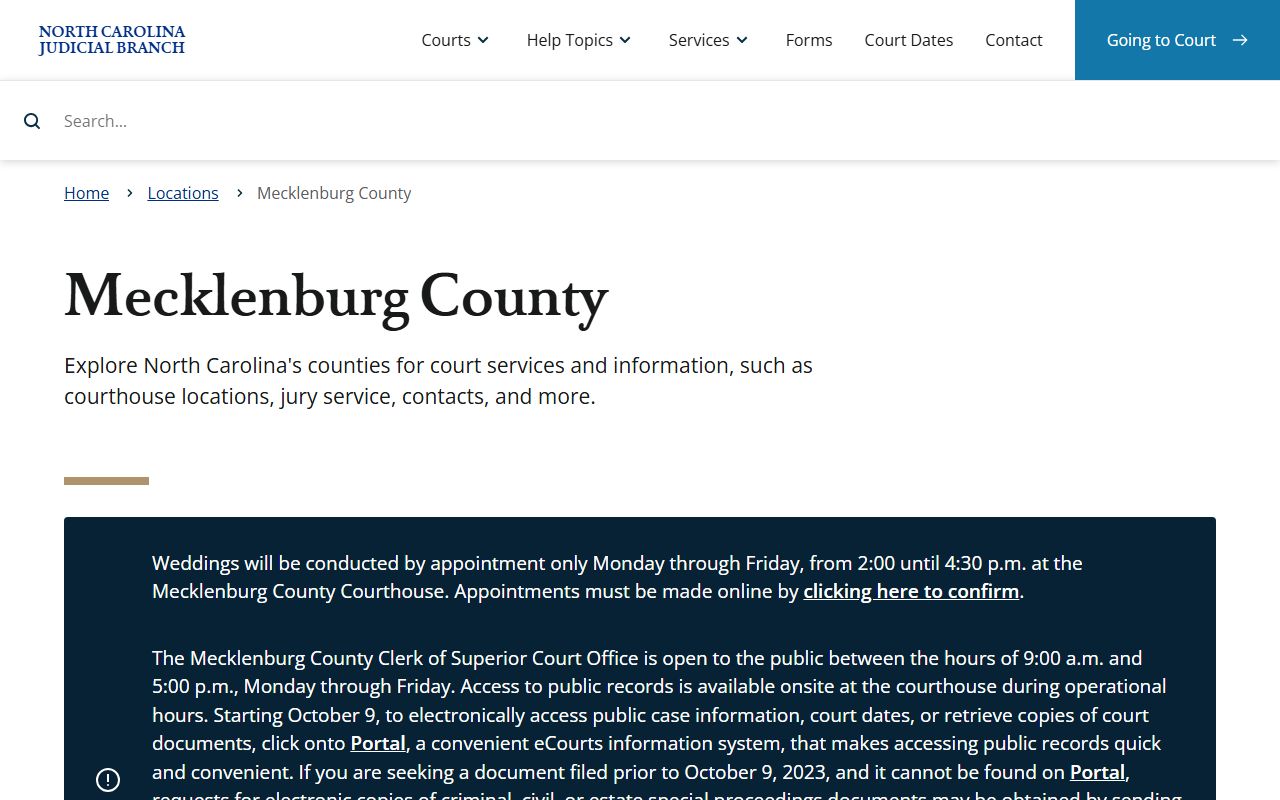
That page is the local bridge between online Portal access, public courthouse records, court calendars, and pre-October 9, 2023 document requests.
Important: Court and jail records should be verified with the Clerk, MCSO, or the agency that maintains the source record.
Public Record Search
Sponsored Results