
The Mecklenburg County Inmate Population
The Mecklenburg County inmate population is centered at Mecklenburg County Detention Center Central, the main adult jail operated by the Mecklenburg County Sheriff's Office. MCSO describes Central as a direct-supervision, pretrial facility and the major detention operations hub for the county. The jail receives people arrested by Charlotte-Mecklenburg Police, town police departments, sheriff's deputies, and other agencies that bring arrestees through the centralized Arrest Processing Center. That means the county count includes more than one arresting agency, but the public jail roster is still run through MCSO.
The local jail count is not the same as the North Carolina prison count. A person arrested in Mecklenburg County may appear in MCSO Inmate Inquiry while held before trial, while serving a short local sentence, or while waiting on a hold, writ, detainer, or transfer. Once a sentenced person moves into North Carolina Department of Adult Correction custody, the statewide NCDAC locator becomes the main search tool. Federal and immigration custody have separate systems, though MCSO prisoner-type filters can show FEDERAL, BOP, ICE, and 287G when that custody class is held locally.
Mecklenburg County Inmate Population Statistics
MCSO's realtime population report is the strongest current source for Mecklenburg County jail figures. The report captured on June 22, 2026 at 07:35 listed the current MCDC-Central population as 2,112, with PREADM at 247 and APC at 1. MCSO warns that the report is a real-time snapshot and may vary from other sources because of methodology and logistical parameters. The official facility page says Central has capacity for more than 1,900 residents after the 2002 tower addition.
| Measure | Figure | Source and Date |
|---|---|---|
| MCDC-Central current population | 2,112 | MCSO realtime population report, June 22, 2026 at 07:35 |
| PREADM count | 247 | MCSO realtime population report, June 22, 2026 at 07:35 |
| APC count | 1 | MCSO realtime population report, June 22, 2026 at 07:35 |
| Booked yesterday | 51 | MCSO realtime population report, June 22, 2026 at 07:35 |
| Released yesterday | 32 | MCSO realtime population report, June 22, 2026 at 07:35 |
| Central built capacity | More than 1,900 residents | MCSO Detention Center Central facility page, captured June 2026 |
Mecklenburg County Inmate Population Trends
The Mecklenburg County inmate population has moved through two different local stories. Safety and Justice Challenge materials describe earlier work to reduce jail use, improve pretrial release decisions, and address racial and ethnic disparities. The same research file also captures a 2026 crowding problem, with Central above the capacity figure stated on the MCSO facility page and local reports describing plans to reopen Detention Center North for adult overflow. Both points matter. Reform work did not make the current crowding issue disappear.
| Year or Period | Population Measure | Notes |
|---|---|---|
| FY 2016 | Central ADP 1,197; North ADP 247 | MCSO FY 2019 annual report historic average daily population chart |
| FY 2019 | Central ADP 1,324; North ADP 227 | MCSO FY 2019 annual report historic average daily population chart |
| 2014 to 2017 | 11% jail population reduction | Mecklenburg County Criminal Justice Services Safety and Justice Challenge page |
| 2019 | Pretrial residents were 63% of ADP | Safety and Justice Challenge Mecklenburg page, updated April 6, 2026 |
| 2020 to 2022 | Average pretrial share was 68% of ADP | Mecklenburg County CJS Safety and Justice Challenge page |
| June 22, 2026 | Central current population 2,112 | MCSO realtime population report |
Who Makes Up the Mecklenburg County Inmate Population
The June 22, 2026 MCSO report shows a jail population dominated by pretrial felony cases. Felony pretrial residents were listed at 1,372, or 64.9%, with an average stay of 251 days. Total felonies were 1,684, or 79.7%. Misdemeanor pretrial residents were 351, or 16.6%, with an average stay of 54 days. Holds and detainers only were listed at 31, or 1.5%, with an average stay of 193 days. Those categories help explain why a roster search may show court processes, probation violations, federal detainers, or immigration holds rather than a simple local charge.
- Sex: the report listed 1,909 male residents and 204 female residents.
- Age: residents ages 25 to 44 made up most of the reported age groups.
- Charge level: total felonies accounted for 79.7% of the reported jail population.
- Race and ethnicity: the report listed African-American residents at 74.4%, Caucasian residents at 14.6%, Hispanic or Latino residents at 9.8%, Other at 1.1%, and Not Recorded at 0.1%.
- Custody class: the MCSO roster can identify state, federal, BOP, ICE, and 287G classes when they are held in the local jail system.
Note: The gender detail totals do not align perfectly with the current population line, so the report's real-time methodology caveat should travel with the figures.
Mecklenburg County Jail Capacity
Central's official facility page says the jail opened in 1997 and added a tower in 2002, bringing capacity to more than 1,900 residents. The June 22, 2026 MCSO report listed 2,112 residents at Central. That comparison shows why recent crowding is not a side issue for Mecklenburg County inmate population data. The facility also carries the Arrest Processing Center, property storage, administrative services, support services, and a full medical component, so overcrowding affects more than housing units.
Detention Center North adds a second layer. The official MCSO page still presents it as Juvenile Detention Center North, a former adult facility converted after North Carolina's Raise the Age law. Research notes also describe 2026 plans to reopen North for adults because Central was over practical capacity. The safest description is a changing facility with adult-jail history, juvenile-detention use, and possible adult overflow use, not a routine adult jail page with no caveat.
Laws Governing Mecklenburg County Jail Records
North Carolina public-records law explains why many jail records can be inspected, while criminal-investigation records and some law-enforcement materials remain restricted. In Mecklenburg County, the practical path is still the MCSO Arrest Inquiry or Inmate Inquiry first, because those tools publish recent arrest and resident data for public use. A records request is a fallback for records not supplied through the public search tools.
Key Statutes:
G.S. 132-1 defines North Carolina public records broadly, including electronic records made or received by public agencies.
G.S. 132-1.4 limits criminal-investigation and intelligence records, while preserving access to specified law-enforcement information.
G.S. 132-1.4A treats law-enforcement recordings differently from routine booking data.
Chapter 153A, Article 10 governs local confinement facilities, including jail authority, standards, and death reporting.
Mecklenburg County State Prison Search
No active NCDAC prison facility was found in Mecklenburg County on the state prison facilities list. Sentenced people from Mecklenburg County who transfer to state custody should be searched through the NCDAC Offender Public Information locator. NCDAC says its records cover state prisoners, probationers, and parolees, and that it does not include local, county, or city jail information. This is a common search error. A person can vanish from the county roster as a current resident because the current custody source has changed.
Search Mecklenburg County Inmates
The main online custody tool is MCSO Inmate Inquiry. The related MCSO Arrest Inquiry covers arrests in the past three years. MCSO says both the arrest and resident inquiry records remain online for three years from arrest or release, and the FAQ says Inmate Inquiry is in real-time mode. New arrests still need to pass through booking, fingerprinting, mugshot capture, identity checks, and records entry before public results make sense.
- Open MCSO Inmate Inquiry for a person believed to be in jail now, or MCSO Arrest Inquiry for an arrest event in the three-year public window.
- Use Actives Only when the person should be in custody now. Leave it unchecked for a released person still inside the public window.
- Search by name, PID, or JID. PID follows the person across jail stays, while JID belongs to one jail stay.
- Use Prisoner Type only when the custody class matters, such as STATE, FEDERAL, BOP, ICE, or 287G.
- Open the result and compare charges with court records, because MCSO warns that charges are not convictions.
Mecklenburg County Inmate Lookup Fields
The MCSO roster accepts several fields, but narrower searches work better. The portal can return a message when more than 500 records match. Name searches should be checked for spelling and widened when no result appears. PID and JID are stronger identifiers when available from prior paperwork, court records, bond documents, or family notes.
| Field Label | Type | Required | Notes |
|---|---|---|---|
| Actives Only | Checkbox | No | Limits results to active/current inmates. |
| Last Name | Text | Unspecified | Maximum length 30 in captured HTML. |
| First Name | Text | Conditional for name search | FAQ says at least one first-name letter must be entered for a name search. |
| PID | Text | No | Positive Identification Number from fingerprint analysis. |
| JID | Text | No | Jail Identification Number for a single jail stay. |
| Prisoner Type | Dropdown | No | Options shown include ALL, STATE, FEDERAL, BOP, ICE, and 287G. |
The MCSO Inmate Inquiry screen shows the field layout directly. The form is useful because it makes the local custody split visible rather than forcing every person into a county-only category.
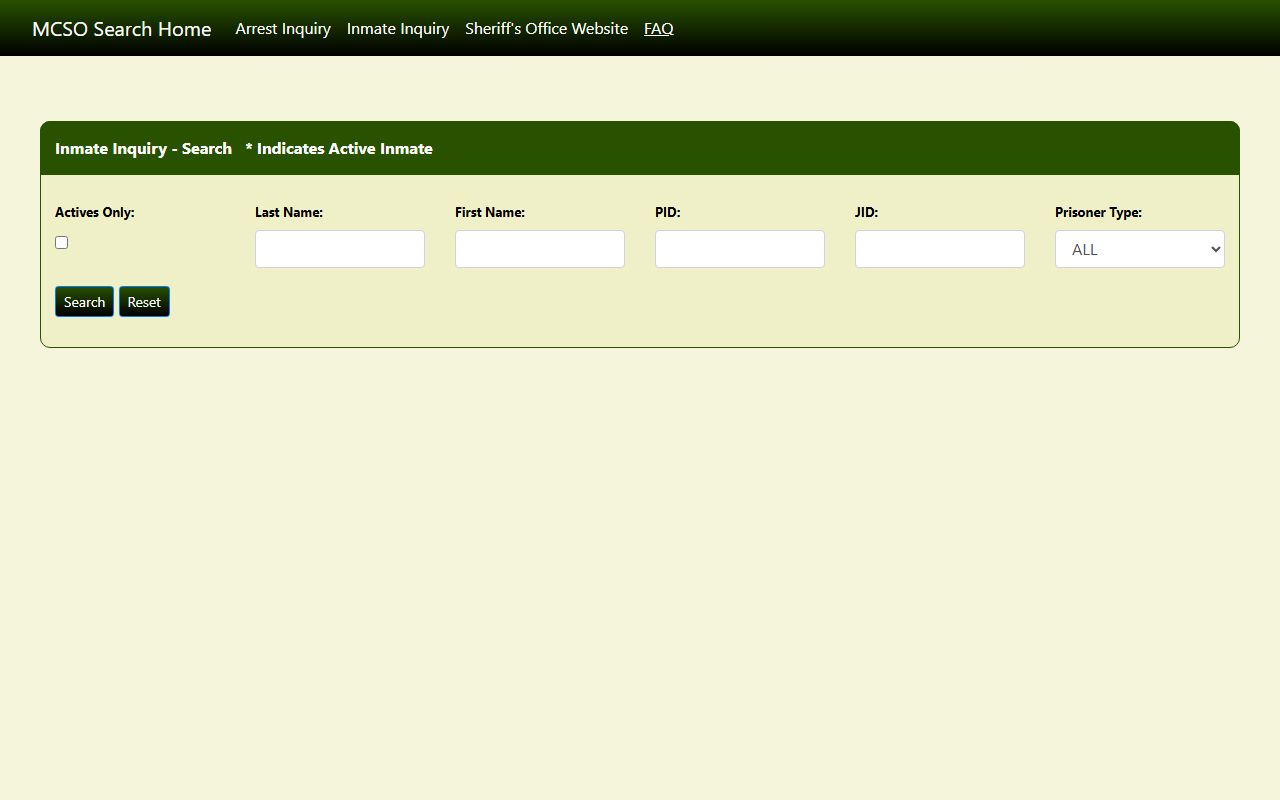
The search form reinforces that name, PID, JID, active status, and prisoner type can all change the result set.
Past Mecklenburg County Inmate Records
Released residents can still appear in MCSO public data during the three-year window. The Resident Inquiry page says arrest and resident inquiry information remains online for three years from arrest or release from the detention center. To remove information before that point, MCSO must receive a judge-signed Order of Expunction. Older jail data, records not published online, or documents outside the search fields may require the Mecklenburg County public-records portal or the office that created the record.
Past custody should also be checked against court and state systems. If the person was sentenced to state custody, search NCDAC. If the case moved into federal custody, use the BOP Inmate Locator for federal inmates from 1982 to the present. If immigration custody is the concern, use ICE Online Detainee Locator System for adults currently in ICE custody or in CBP custody more than 48 hours.
What Mecklenburg County Inmate Records Show
MCSO result cards and the FAQ give a detailed field inventory. Public inmate cards show a mugshot, name, PID, JID, date of birth, race, ethnicity, sex, height, and weight. Arrest cards show mugshot, name, PID, arrest number, arrest date, date of birth, race, ethnicity, and sex. Charge detail can include trial court case number, charge description, process type, charge type, bond amount, bond type, and disposition code.
| Field | What It Shows |
|---|---|
| PID | Fingerprint-based Positive Identification Number that stays constant across jail stays. |
| JID | Jail Identification Number assigned to one booking or jail stay. |
| Mugshot | Booking photo displayed on public cards when available. |
| CASE | Trial court case or docket number tied to a charge. |
| Bond Type | Codes such as SEC, UNS, CASH, CUST, VDGJ, or NONE. |
| Disposition | MCSO jail-status code, not the final court outcome. |
Mecklenburg County Jail vs Prison
County jail, state prison, federal prison, and immigration detention are separate custody systems. A Mecklenburg County inmate population search works best when the likely custody system is chosen first. Jail records answer booking, current custody, local charge, bond, and release questions. Court records answer charge status and disposition questions. State and federal locators answer prison placement questions after transfer.
| County Jail | State Prison | Federal or ICE | |
|---|---|---|---|
| Primary agency | Mecklenburg County Sheriff's Office | North Carolina Department of Adult Correction | BOP, ICE, or U.S. Marshals context |
| Typical status | Pretrial, local sentence, hold, transfer wait | Sentenced prison, probation, parole | Federal sentence, federal pretrial custody, or immigration custody |
| Search tool | MCSO Inmate Inquiry | NCDAC Offender Public Information | BOP locator or ICE ODLS |
| County jail data included? | Yes | No, per NCDAC public records guidance | Only if a local MCSO record also exists |
State Federal ICE Lookup
Use NCDAC Criminal Offender Searches or the OPI locator when a Mecklenburg case has become a state prison, probation, or parole matter. Use BOP for sentenced federal inmates from 1982 forward. Use ICE ODLS for adult detainees in ICE custody or in CBP custody more than 48 hours. Use North Carolina VINE as a notification service for custody or case-status changes, not as the official roster of record.
- Detainer
- A hold or request from another agency that may delay release from the county jail.
- Pretrial
- A person held before final court disposition or sentencing.
- Expunction
- A judge-signed order that can remove eligible public record information.
- VINE
- A custody and case notification service that supplements official records.
Mecklenburg County Detention Facilities
The facility map has two Mecklenburg County detention pages. Central is the main adult jail and booking hub. North has a more complex history because it was formerly an adult jail, then Juvenile Detention Center North after Raise the Age, with 2026 adult overflow plans noted in research.
- Mecklenburg County Detention Center Central holds adult pretrial residents, sentenced misdemeanants, holds, transfer classes, and the Arrest Processing Center workflow.
- Mecklenburg County Detention Center North / Juvenile Detention Center North has adult jail history, juvenile detention use, and 2026 adult overflow context.
Mecklenburg County Inmate Population FAQ
How big is the Mecklenburg County inmate population?
The MCSO realtime population report captured June 22, 2026 at 07:35 listed MCDC-Central at 2,112 residents, plus PREADM and APC figures. The official facility page says Central has capacity for more than 1,900 residents.
How do I search the Mecklenburg County inmate population?
Use MCSO Inmate Inquiry for current and recent jail residents. Use MCSO Arrest Inquiry for arrest records from the past three years. Check state, federal, ICE, or VINE systems when local results do not match the custody situation.
Can I look up a released Mecklenburg County inmate?
Yes, if the record remains inside MCSO's three-year public window. For older records, use the county public-records request process or the office that created the record.
Do Mecklenburg County jail charges prove conviction?
No. MCSO warns that charges are not convictions. Use the Mecklenburg County court records after jail arrest workflow for case status, dispositions, and court dates.
Public Record Search
Sponsored Results